Amanda notices a rhythmic clicking sound that only shows up when she turns into her driveway — present on the turn, gone the instant she straightens out. Nice diagnostic skills, Amanda! That timing is a genuinely useful clue about where to start looking.
🔧 The Most Common Cause: A Worn CV Joint
If your car is front-wheel drive, and most are, the motor turns the transmission, which turns the drive wheel of the car. Between the transmission and the wheel is something called a Constant Velocity (or CV) joint. It allows the wheel to ride up and down over bumps and steer with the steering wheel while providing smooth, consistent power from the transmission.
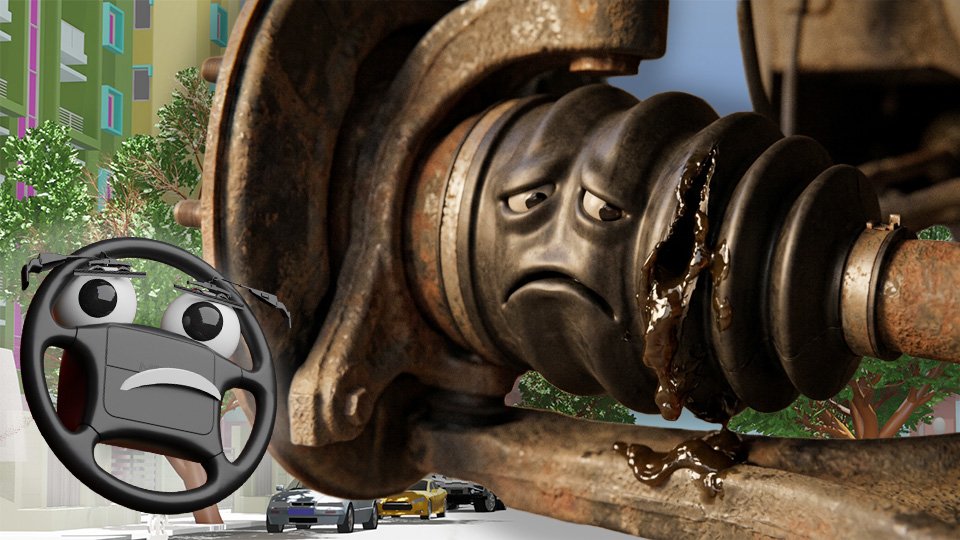
The CV joint has a rubber boot over it. The boot, packed with grease, keeps dirt and water and stuff out of the bearings in the CV joint.
A worn or damaged CV joint, especially one with a torn protective boot letting grease escape and dirt in, produces a distinct clicking or popping sound specifically when turning, most pronounced during tight, low-speed turns like parking lot maneuvers.
🔍 A Quick Way to Check the Boot
The rubber boot covering the CV joint is visible from underneath, near where the axle meets the wheel hub.
Take a flashlight with you. Look for a torn boot, or grease flung around the inside of the wheel well. If you see those things, it’s visible confirmation that the CV boot has gone south.
🛎️ Other Suspects Worth Ruling Out
A worn wheel bearing can produce noise that changes with turning, though it’s often more of a humming or grinding that changes pitch with speed rather than a sharp click.
Loose or worn suspension components — sway bar links, ball joints — can also produce a clicking or clunking specifically under the twisting load of a turn. But that noise is more often a thunk than a clicking.
⚠️ Why a Torn CV Boot Isn’t a Wait-It-Out Problem
Once the protective boot tears, the joint’s grease escapes and road grit gets in — a joint that was fine yesterday starts wearing rapidly once that protective barrier is gone.
A torn boot caught early is a relatively inexpensive fix; a fully failed CV joint (which can eventually separate) is a considerably bigger repair and, in the worst case, a safety issue.
🔊 The Stethoscope Trick
If your adventurous, you can use an automotive stethoscope to pinpoint the exact source of the noise.
- Turn the car’s wheel to one side.
- Get the car up on a jack stand (never just on the jack)
- Press a mechanic’s stethoscope pressed the CV joint
- Have as assistant gently rock the wheel from side-to-side
This method will help you more precisely identify the source of the clicking. In either case, the car will need to go into the hands of an experienced mechanic.
🛠️ Gear Worth Having
ABN Mechanics Automotive Stethoscope Kit — isolate exactly which component is clicking rather than guessing from the driver’s seat.
TEKTON 1/2″ Drive Click Torque Wrench — confirm wheel and suspension hardware is properly torqued, ruling out simple looseness before assuming a worn part.
Autel AL319 OBD2 Scanner — some wheel speed sensor issues tied to bearing wear will throw a code worth checking.
As an Amazon affiliate, I earn from qualifying purchases. Thank you for supporting GrumblePark.
🔗 Related Reads
- Rattling at Idle vs. Rattling Over Bumps
- Knocking Under Acceleration: When to Worry
- Grinding When You Brake: What It Actually Means
GrumblePark is part of the WhistleBump group – find the rest of the family at WhistleBump.com.
47003
©2026 John D Reinhart/GrumblePark.com — All rights reserved