
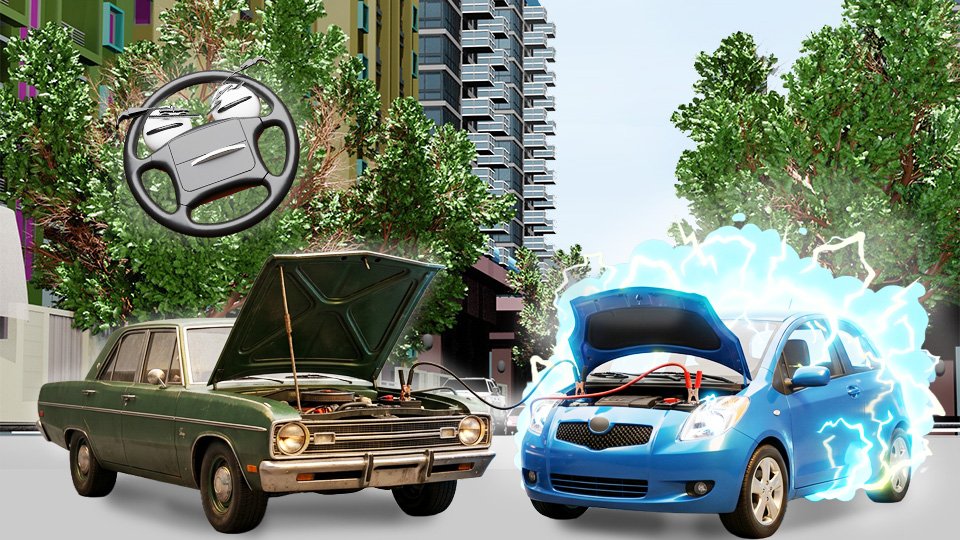
Armando has jump-started a car exactly twice in his life, both times by shouting the general concept of “red to red, black to black, I think?” across a parking lot while a stranger held the other end of the cables, and both times it worked, which taught him precisely nothing about whether he’d actually done it correctly.
🔴 The Order Actually Matters
Connect in this exact sequence:
- positive (red) clamp to the dead battery’s positive terminal,
- positive (red) clamp to the good battery’s positive terminal,
- negative (black) clamp to the good battery’s negative terminal,
- and the final negative (black) clamp to an unpainted metal surface on the dead car’s engine or frame — not the dead battery’s negative terminal itself.
That last detail is the one almost everyone skips, and it’s there for a real reason.
⚡ Why the Last Clamp Doesn’t Go on the Battery
Inside your car’s battery are a bunch of plates — some made of lead, some made of lead dioxide — stacked in alternating layers and dunked in a bath of sulfuric acid mixed with water, called the electrolyte. Charging a battery involves a chemical process that naturally produces a small amount of hydrogen gas as a byproduct — this is completely normal, expected behavior for a healthy, undamaged battery, not a sign anything’s wrong with it. And a jump start is exactly the kind of situation that produces more of it than usual: you’re pushing a strong burst of current into a battery to recharge it quickly, which is precisely the condition that increases hydrogen venting.
So there’s a small amount of that gas present essentially every time you jump-start a car, healthy battery or not — which is exactly why the final clamp still doesn’t go on the battery itself.
Connecting it directly to the dead battery’s negative post creates a spark right at the exact spot where that gas is naturally escaping, a genuine, if uncommon, explosion risk.
Grounding it to bare metal elsewhere on the engine puts that final spark safely away from the battery, gas or no gas — treat it as standard procedure every time, not just a precaution for a battery that looks damaged.
🔇 Which Car Goes First
Once the cars are connected, start the working vehicle and let it run for a couple of minutes before attempting to start the dead one.
When you first start a car, the battery uses all of its cold-cranking amps to turn the engine over and get it started.
Running the engine on the operation car allows the good battery to begin feeding the dead with one some charge before you ask the dead car’s starter motor to do its harder work.
❌ What to Never Do
Never jump a battery that’s visibly cracked, leaking, or frozen — all three carry real risk of rupture under the added electrical load.
And NEVER let the two clamps touch each other while the other ends are connected to anything!
This is a genuinely bigger deal than it sounds. The moment a red (positive) clamp touches a black (negative) clamp, you’ve created a direct short circuit: an almost zero-resistance path straight between the battery’s two terminals, with none of the car’s normal electrical components in the way to control how much current flows.
Under normal operation, electricity flowing through your car’s wiring is limited and managed by everything it’s actually powering — headlights, the starter motor, and so on.
A direct clamp-to-clamp touch skips all of that entirely, and a car battery (especially with a second battery or jump starter also feeding into the circuit) can push a genuinely massive burst of current through that accidental connection in an instant.
That sudden surge generates real heat at the contact point almost immediately — enough to throw sparks, enough to burn you if you’re holding the clamps when it happens, and enough to damage the clamps or cables themselves.
And remember that hydrogen gas we mentioned a battery can vent, especially one that’s been under load — a spark landing near that gas is exactly the kind of ignition source that turns “oops” into something genuinely dangerous.
The practical takeaway: treat the two colors like they’re supposed to be strangers for the entire process. Keep the loose ends physically separated as you work, don’t let extra cable coil up in a way where a stray clamp could flop against the wrong one, and connect them one at a time in the order already covered above, rather than holding both ready in the same hand.
🔋 Portable Jump Starters: The No-Second-Car Option
A portable lithium jump starter carries its own charge and needs no second running vehicle at all.
Connect its clamps directly to the dead battery, following the same red-then-black order, and it supplies the jump on its own.
Genuinely useful for anyone who’s ever been stuck alone with no one to ask for a favor.
📺 Worth Watching Once Before You Try It
Everything above explains the why — why the order matters, why the last clamp goes on bare metal instead of the battery itself, why the colors need to stay strangers.
But there’s a real gap between reading about clamping a cable onto a terminal and actually doing it with your own hands, in a slightly awkward engine bay, on the first cold morning you actually need to.
A quick video search for “how to jump start a car” gives you that missing piece — watching someone’s hands move through the actual sequence once, seeing exactly what a battery terminal looks like in real life, what a confident clamp connection looks and sounds like versus a loose one.
It doesn’t replace anything covered here; it just turns the steps from something you’ve read into something you’ve already watched happen, so the first time you’re doing it for real isn’t also the first time you’re seeing it done.
🛠️ Gear Worth Having
NOCO Boost X GBX155 Jump Starter — a genuinely powerful, well-reviewed portable jumper that handles larger engines without needing a second car.
LOKITHOR JT400 Jump Starter with Battery Tester — combines the jump-start function with a built-in tester, so you can check the battery’s health right after.
As an Amazon affiliate, I earn from qualifying purchases. Thank you for supporting GrumblePark.
🔗 Related Reads
- Battery vs. Alternator: The Classic Misdiagnosis
- How Long Should a Car Battery Actually Last
- Why Your Dome Light Left On Overnight Can Kill Your Battery
GrumblePark is part of the WhistleBump Group — find the rest of the family at WhistleBump.com.
43001
©2026 John D Reinhart/GrumblePark.com — All rights reserved