
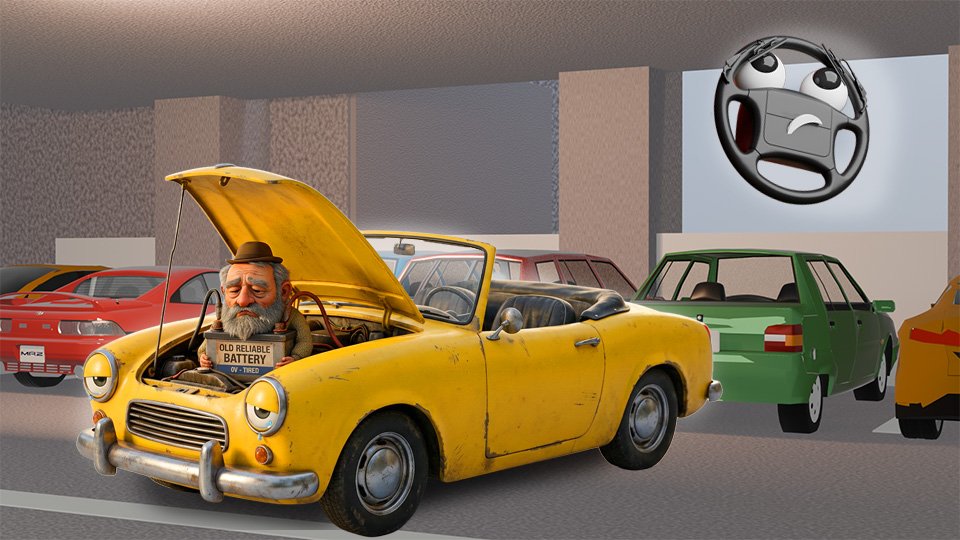
Armando has no idea how old his current car battery is, which battery came before it, or when either one was installed — a genuinely common gap, since nothing about a battery announces its age until the day it very suddenly does.
🔋 Mechanical World 101: What’s Actually in That Box
Alright, everyone, find your seats — today’s lecture is short, and there won’t be a quiz, mostly because Armando would fail it and feelings would get hurt.
Pop the hood, look at that black rectangular brick, and you’re looking at one of the oldest, crankiest pieces of chemistry still doing honest work in the modern world: the lead-acid battery, a design that’s barely changed since the 1800s. It turns out you can’t really improve on “put two different metals in acid and see what happens.”
Inside that case are a bunch of plates — some made of lead, some made of lead dioxide — stacked in alternating layers and dunked in a bath of sulfuric acid mixed with water, called the electrolyte.
Here’s the whole deal: those two different lead materials genuinely do not want to sit in acid together peacefully. A chemical reaction happens between them, and that reaction produces electrons that want very badly to get away from one plate and over to the other.
Give those electrons a path to travel — a wire, say, running to your starter motor — and that desperate electron migration is electricity. You’re not powering your car with magic. You’re powering it with a fight between two pieces of lead that acid started and hasn’t let either one win.
When the engine starts and the alternator takes over (covered in its own post), it runs that same chemical reaction backward, shoving the electrons back where they came from and resetting the fight for next time. That’s what “recharging” actually means at the chemistry level — not filling up a tank, but un-arguing an argument.
📅 The Honest Range
Most car batteries last three to five years under typical conditions — a range instead of a precise number, because the factors that determine where you land in it vary a lot from car to car and climate to climate.
🔥 Heat Kills Batteries Faster Than Cold Does
This one’s a surprise: sustained heat, not cold, is the bigger long-term threat to battery life.
High temperatures accelerate that internal lead-and-acid argument we just covered, wearing the plates down faster, even though cold weather is when a weakened battery finally, visibly fails to crank the engine.
🚗 Short Trips Are Genuinely Hard on a Battery
Starting the engine draws a real chunk of charge, and a short drive may not run long enough for the alternator to fully replace what the start consumed.
A car used mostly for short trips can leave its battery chronically undercharged, arguing with itself and never getting fully reset.
🧪 Can You Get It Checked? Absolutely, and It’s Free
You don’t need to own a single tool to know your battery’s actual health — most auto parts stores will run a free load test in about five minutes if you drive or walk in with the battery in hand.
A load test does exactly what it sounds like: it puts the battery under a simulated version of the demand a starter motor makes, then watches how well the voltage holds up under that stress.
A tired battery will sag noticeably; a healthy one barely blinks. This is genuinely the easiest, lowest-effort diagnostic step in this entire post, and it costs nothing.
🔧 Can You Replace It Yourself?
Here’s some good news, actually: swapping a car battery is one of the more approachable DIY jobs on the whole site — genuinely more like changing a large, heavy remote-control battery than anything resembling real engine repair. There’s no fluid to drain, no complex system to reassemble, just two cable clamps and a bracket holding the whole thing in place.
The order matters, though, and it’s the reverse of what you might guess: disconnect the negative terminal first, then the positive — the opposite order from jump-starting, and for the same underlying safety reason, minimizing the chance of a spark near the battery. When installing the new one, it’s positive first, negative second. A basic wrench (commonly 10mm) handles most terminal clamps.
One more thing worth knowing: old car batteries can’t just go in the trash — they’re required by law in most states to be recycled.
Most auto parts stores will take your old one for free the moment you buy a new one there, no extra errand required. Some will even install it for you on the spot if you bought it in-store.
🛠️ Gear Worth Having
LOKITHOR JT400 Jump Starter with Battery Tester — check remaining battery health directly, at home, instead of guessing from the install date.
NOCO NCP2 Battery Terminal Cleaning Kit — clean terminals let a battery deliver its full remaining capacity instead of losing power to corrosion.
Battery Service Tool Kit (Puller, Wrenches, and Brush) — everything needed for a genuine DIY swap in one small kit, including the wrench sizes that fit most terminal clamps.
As an Amazon affiliate, I earn from qualifying purchases. Thank you for supporting GrumblePark.
🔗 Related Reads
- Terminal Corrosion: Why It Happens and How to Clean It
- Why Your Dome Light Left On Overnight Can Kill Your Battery
- Battery vs. Alternator: The Classic Misdiagnosis
Class dismissed. No homework, unless you count remembering which terminal comes off first.
GrumblePark is part of the WhistleBump Group — find the rest of the family at WhistleBump.com.
43003
©2026 John D Reinhart/GrumblePark.com — All rights reserved