
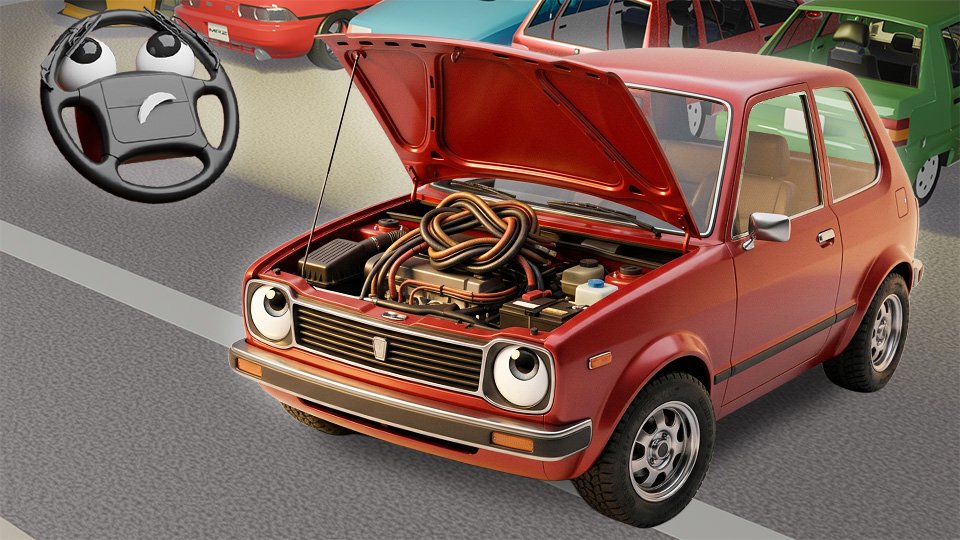
Amanda’s cigarette lighter outlet stopped charging her phone one day, and her first instinct was to assume something expensive and internal had failed. It was a two-dollar fuse. It’s very often a two-dollar fuse.
⚡ First, What a Fuse Actually Does
Picture your car’s electrical system like water flowing through a hose — electricity is the water, and the wire is the hose carrying it to wherever it’s needed, whether that’s a headlight, a radio, or that cigarette lighter outlet.
Too much water pressure can burst a hose or damage whatever it’s connected to; too much electrical current can overheat a wire and, in a worst case, start a fire.
A fuse is a deliberately weak link built into that path on purpose – a thin metal wire designed to melt and break the connection the instant too much current tries to push through it, sacrificing itself to protect the far more expensive wiring and components downstream. When a fuse “blows,” it didn’t fail. It did exactly the job it was built for.
When something electrical in the car stops working, be it the radio or a phone charger or even the power windows, the first suspect in the lineup is a fuse.
🔌 What Are We Even Talking About?
Before diving in, a quick picture of the two parts this whole post is about.
A fuse is a small plastic housing, usually about the size of your pinky nail, with two metal prongs sticking out the bottom and a thin wire visible right through the clear or colored plastic connecting them.
A relay is a small, boxy plastic cube, usually an inch or so across, that plugs into its own slot the same way a fuse does, just bigger. Both live in the same general neighborhood — a fuse box — and both exist to protect your car’s electrical system, just in slightly different ways.
🔍 Finding the Fuse Box
Most cars have two fuse boxes — one tucked inside the cabin, usually a black plastic panel near the driver’s left knee or behind a small door on the dashboard, and a second one under the hood, typically a larger black box sitting near the battery.
Both usually have a lid that pops or unclips off, and printed on the underside of that lid is almost always a small diagram — a grid of icons or abbreviations, each one lined up with a specific fuse slot, telling you which fuse controls which part of the car.
Your owner’s manual will point you to the exact location for your specific model if you can’t spot either box right away.
🔧 How to Actually Check and Swap One
Pull the suspect fuse straight up and out using a small plastic fuse puller — a little tool shaped like a pair of tweezers, usually clipped into the fuse box itself.
Hold the fuse up to a light and look at that thin wire running between the two prongs: intact and unbroken means the fuse is fine, visibly snapped or blackened means it’s blown.
Pushing a new one in is genuinely as simple as it sounds — line up the prongs and press down firmly until it seats, no different from swapping a small lightbulb.
One detail that actually matters here: every fuse is stamped with a number (its amperage rating) and color-coded to match, and your replacement needs to match the blown one exactly — never a higher number “just to be safe.”
A higher-rated fuse defeats the entire point of having one at all, letting more current through than the wiring behind it was ever designed to handle safely.
🔁 Relays, Briefly
A relay solves a different problem: some parts of your car — like your headlights — need a lot of power to run, more than the thin little wire running to your dashboard switch could safely carry all the way.
So instead, that thin wire carries just a small trigger signal to the relay, and the relay itself, sitting closer to the part that needs the power, completes a separate, heavier-duty circuit using its own thicker wiring.
Think of it like a doorbell: pressing the button doesn’t power the chime directly through the wire in your hand — it just sends a small signal that tells a separate, more capable circuit to do the actual work.
If swapping a fuse doesn’t fix the issue and a relay’s suspected instead, that’s a good moment to hand it off to a shop — confirming a relay’s actually bad involves swapping it against a known-good one to compare, a step beyond what’s worth owning special tools for over a single incident.
⚠️ When a Blown Fuse Means Something Else Is Wrong
If a fresh replacement fuse blows again immediately, that’s not bad luck — somewhere downstream, two wires that shouldn’t be touching are touching (called a short circuit), creating an unintended path that draws far more current than the circuit was ever meant to carry.
Repeatedly swapping in fresh fuses just keeps sacrificing two-dollar parts to paper over a real problem underneath. A repeat blow is the actual signal to stop and get it looked at, not a reason to try a third fuse.
🗣️ Even If You’d Rather Not Do This Yourself, It’s Still Worth Knowing
Maybe popping open a fuse box and poking around under there just isn’t something you want to do, and that’s completely fine — nothing above requires you to become the person who does it. But knowing what you just read still pays off the moment you’re standing at a mechanic’s counter, in a few concrete ways.
You can describe the actual problem, not just the symptom. “My cigarette lighter stopped working” gets you a diagnostic fee and a wait. “My cigarette lighter stopped working, and I checked the fuse box diagram — it’s fuse 23, and it looks blown to me” gets you straight to a two-minute fix, because you’ve already done the hardest part of the diagnosis yourself.
You’ll know if a quote actually makes sense. If a shop tells you it’s a blown fuse, you now know that’s genuinely a couple of dollars in parts and a couple of minutes of labor — not a $150 job. That doesn’t mean every shop is trying to take advantage of you; a legitimate diagnostic fee for tracking down which fuse and why it blew is real, honest work. But you’ll be able to tell the difference between “we found and fixed a simple fuse” and “we’re charging you like this was something bigger,” and ask the right follow-up question if the two don’t line up.
You’ll know what question actually matters. A single blown fuse, once, is usually nothing. A fuse that keeps blowing is a real problem hiding underneath it. Knowing that distinction means you can walk in and ask specifically, “was it just the fuse, or is something making it blow?” — the exact question that separates a simple swap from a repair that’s actually being deferred.
None of this requires you to ever touch a fuse box yourself. It just means you’re never standing there nodding along to something you don’t understand — you’re asking the one question that actually protects your wallet
🛠️ Gear Worth Having
Automotive Fuse Assortment Kit — keep the common amperage ratings on hand so a blown fuse is a two-minute fix, not a trip to the store.
Vehicle Maintenance Log Book — note which fuse blew and when — useful if it turns out to be a repeat problem worth mentioning to a mechanic.
As an Amazon affiliate, I earn from qualifying purchases. Thank you for supporting GrumblePark.
🔗 Related Reads
- How Your Alternator Keeps Everything Running
- Battery vs. Alternator: The Classic Misdiagnosis
- Terminal Corrosion: Why It Happens and How to Clean It
GrumblePark is part of the WhistleBump Group — find the rest of the family at WhistleBump.com.
43004
©2026 John D Reinhart/GrumblePark.com — All rights reserved