
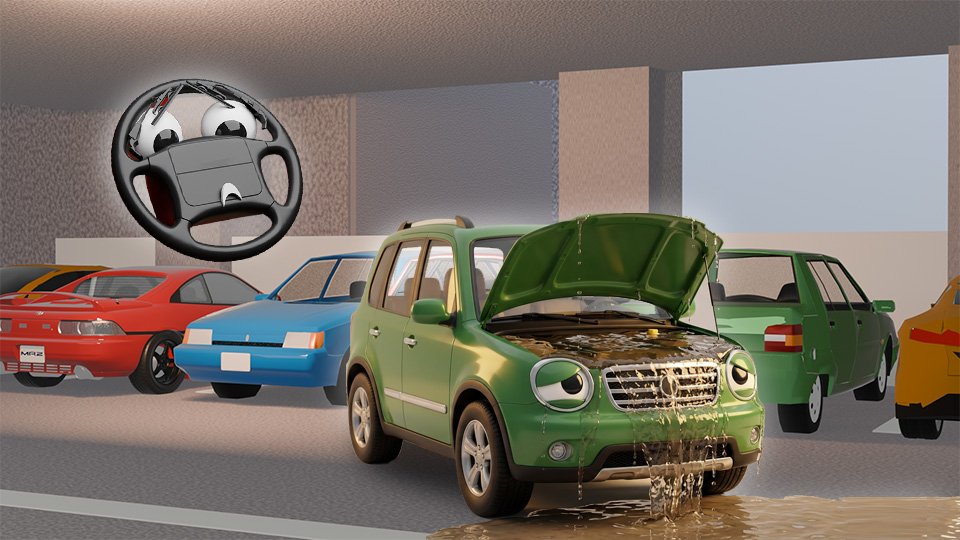
Amanda’s instinct, when checking a fluid and finding the level a little low, has always been to just keep adding a bit more “to be safe” — reasoning that if some fluid is good, more fluid can only be better. It’s an understandable instinct, and it’s exactly backwards for several of the fluids covered across this whole category.
📉 Why Underfilling Is the Obvious Half of the Problem
Low fluid means whatever job that fluid does — lubricating, cooling, transmitting force — gets done less effectively, or not at all in the worst spots. This is the half of the story most people already understand intuitively, and it’s why a low-level warning light gets taken seriously.
📈 Why Overfilling Engine Oil Specifically Causes Real Damage
Too much oil in the engine lets the spinning crankshaft actually contact the pooled oil at the bottom, whipping it into a foam full of tiny air bubbles. Foamy oil doesn’t lubricate properly — it compresses instead of cushioning, which can starve bearings of proper lubrication even though the dipstick technically shows “plenty.” More is not better here; more is a different problem.
💧 Coolant: Room Needed for Expansion
A coolant system needs a little empty space at the top, because the fluid expands as it heats up. Overfilled coolant has nowhere to go and can be pushed out through the overflow the moment the engine reaches operating temperature — which looks like a leak, isn’t actually a leak, and just means it was filled past the max line to begin with.
🛑 Brake and Power Steering Fluid: A Tighter Margin
These reservoirs are sized deliberately close to their working volume. Overfilling either can cause fluid to be pushed out through a vent or seal as the system heats up during normal driving — a slow, sticky mess rather than a dramatic failure, but a mess worth avoiding.
✅ The Actual Rule
Fill to the middle of the marked range, not the top of it, whenever a fluid gives you a range rather than a single line — and if you’re not sure, checking again after a short drive, once everything’s reached normal operating temperature, beats guessing on the first pass.
🛠️ Gear Worth Having
EWK Flexible Oil Funnel — a controlled, gradual pour makes it far easier to stop right at the line instead of overshooting.
Antifreeze/Coolant Refractometer — confirms concentration is correct too, not just that the level looks right in the reservoir.
Vehicle Maintenance Log Book — note what level you filled to — useful context the next time you check, so you’re comparing against a real number, not memory.
As an Amazon affiliate, I earn from qualifying purchases. Thank you for supporting GrumblePark.
🔗 Related Reads
- How to Check Your Fluid Levels in Under Five Minutes
- Engine Oil: What It Actually Does Beyond “Lubrication”
- Coolant: Why It’s Not Just Water and Why the Color Matters
GrumblePark is part of the WhistleBump Group — find the rest of the family at WhistleBump.com.
41010
©2026 John D Reinhart/GrumblePark.com — All rights reserved