
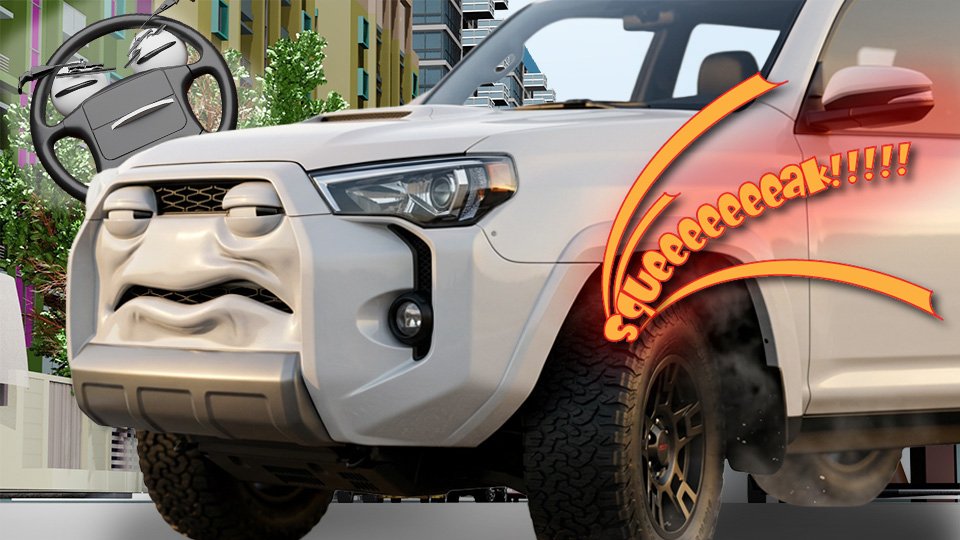
Armando has always relied entirely on his mechanic to tell him when brake pads need replacing, on the assumption that checking this himself would require tools or knowledge he doesn’t have. It genuinely doesn’t — this is one of the more accessible checks on the whole car, and it starts with just looking.
👀 The Visual Check Through the Wheel
Look at one of your wheels and you’ll notice the metal rim has gaps or slots in it — those are the spokes. Through those gaps, you can usually see straight into the wheel, where a flat metal disc (the rotor) sits with a thinner piece of material pressed against it on each side (the pad). That pad material is what you’re checking. If it looks like a decent, healthy slab — thicker than a couple of stacked coins — you’re fine. If it looks thin, more like a sliver than a slab, that’s your sign it’s getting close to time.
📏 A Direct Measurement Beats Eyeballing
Lighting and the angle through which you’re peering through the spokes can make a guess-by-eye surprisingly unreliable — the same pad can look “probably fine” or “probably not” depending on where the sun is. A small tool called a brake pad thickness gauge solves that by sliding right up against the pad material itself and giving you an actual number instead of a squint and a shrug.
🔔 The Squeal Is an Intentional Signal, Not Bad Luck
Here’s something most drivers seldom get told: a lot of brake pads have a tiny metal tab built into them specifically to make noise once the pad wears down far enough — a built-in alarm, on purpose.
So if you hear a high-pitched squeal that only happens while you’re actually braking, and goes quiet the moment you let off the pedal, that’s very likely your car deliberately trying to get your attention, not just an odd noise to shrug off.
⚖️ Uneven Wear Between Wheels Is Its Own Signal
If you check all four wheels and one pad looks noticeably thinner than the rest, that’s worth mentioning to a mechanic specifically, not just something to replace and forget. It often means something else on that wheel (like a part that’s not fully releasing after you brake) is quietly wearing that one pad down faster than it should.
Worth describing exactly what you found, since “one wheel’s pad looked thinner” is a genuinely useful detail for whoever ends up diagnosing it.
🚗 The Feel Test, For What It’s Worth
Here are a couple of early hints worth paying attention to:
- The brake pedal seems to need to go down further than it used to before the car actually starts slowing
- Stopping just feels like it takes a bit longer than it used to
If you feel either one of these while driving, it might be worth having the brake system examined by a professional.
🛠️ Gear Worth Having
Camrusic Brake Pad Thickness Gauge — an actual measurement instead of guessing through the wheel spokes, no disassembly involved.
HeroBeam Car Emergency Flashlight (Twin Pack) — shine it through the spokes and you can actually see what you’re looking at instead of squinting into a dark wheel well.
ABN Mechanics Automotive Stethoscope Kit — if you hear a squeal and want to confirm which wheel it’s actually coming from before describing it to anyone.
As an Amazon affiliate, I earn from qualifying purchases. Thank you for supporting GrumblePark.com.
🔗 Related Reads
- That Grinding Noise Means You Waited Too Long
- Ceramic vs. Semi-Metallic vs. Organic Brake Pads
- How Brakes Actually Work: Pads, Rotors, and Calipers Explained
GrumblePark is part of the WhistleBump group – find the rest of the family at WhistleBump.com.
45006
©2026 John D Reinhart/GrumblePark.com — All rights reserved