
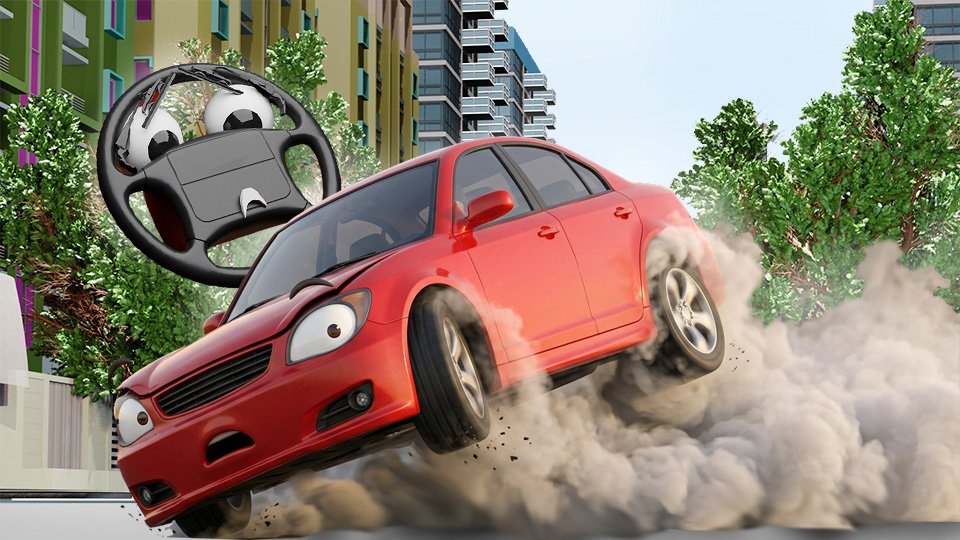
Armando slammed the brakes once to avoid a deer, felt the pedal pulse rapidly under his foot, and spent the rest of the drive genuinely convinced something had just broken — when in fact something had just worked exactly as intended, for the first time he’d ever actually needed it to.
🔒 What Wheel Lockup Actually Costs You
When you jam on the brakes, the brake calipers seize the wheel rotors with all their power. This immediately stops the wheels from rotating, causing the tires to skid across the pavement.
A locked, skidding tire — one that’s stopped rotating but is still sliding across the pavement — generates less friction, and therefore less stopping power, than a tire that’s still rotating right at the edge of traction.
A locked wheel also can’t provide any steering control at all — a skidding car goes wherever momentum carries it, not wherever the wheel is pointed.
⚙️ What ABS Actually Does About It
Anti-lock Braking System uses a sensor at each wheel to detect the exact moment a wheel is about to lock up, then rapidly releases and reapplies brake pressure at that wheel — many times per second, far faster than you could ever manually pump the brakes — keeping each wheel right at the edge of traction instead of fully locked.
Instead of skidding out of control, the tires are still in contact with the pavement, giving you time to manage the steering, until the cars slows to a stop.
📳 Why the Pedal Pulses
That rapid apply-release cycling is mechanically transmitted straight back through the brake lines to the pedal itself, which is exactly why you feel a pulsing or slight vibration under your foot during an ABS event.
It’s the physical sensation of the system doing its job many times per second, not a sign of a problem.
✅ The Correct Response: Keep Pressing, Don’t Pump
With ABS, the correct technique is to press the pedal firmly and hold it. Let the system handle the rapid pulsing on its own.
Manually pumping the brakes, the old pre-ABS technique, actually works against the system and can reduce its effectiveness.
🚨 What an ABS Warning Light Means
A separate ABS warning light on the dashboard, distinct from the general brake warning light, means the anti-lock system has detected a fault and disabled itself.
Normal hydraulic braking still works, but you’ve lost the anti-lock protection specifically.
This is a genuine “get it looked at” light, not an emergency, but worth acting on rather than ignoring.
🛠️ Gear Worth Having
Autel AL319 OBD2 Scanner — an affordable way to read exactly what triggered an ABS warning light instead of guessing.
Innova 5610 OBD2 Scanner — a step up with ABS-specific diagnostic support, for a more detailed reading of what’s going on.
As an Amazon affiliate, I earn from qualifying purchases. Thank you for supporting GrumblePark.
🔗 Related Reads
- Soft Brake Pedal: What It Means and Why It’s Urgent
- How Brake Bleeding Works (and Why Air in the Lines Is a Problem)
- How to Handle a Skid (Front-Wheel vs. Rear-Wheel Drive)
GrumblePark is part of the WhistleBump Group — find the rest of the family at WhistleBump.com.
45004
©2026 John D Reinhart/GrumblePark.com — All rights reserved