
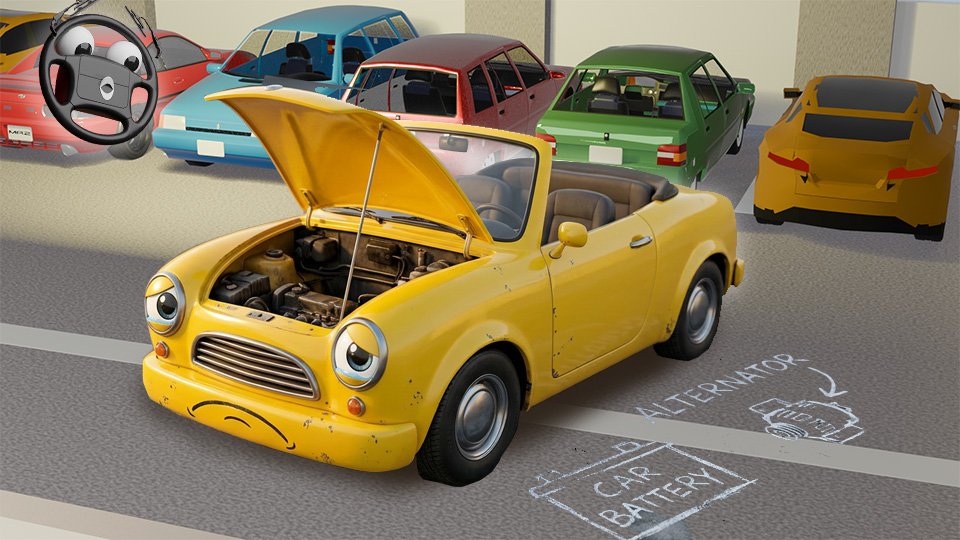
Amanda’s car wouldn’t start one morning, she had it jumped, drove around for two days feeling relieved, and then it happened again — at which point she bought a brand new battery, on the entirely reasonable assumption that the thing that wouldn’t hold a charge was the thing that stores the charge. It wasn’t the battery. It was never the battery.
🔋 What Each One Actually Does
A car battery is built to sit there fully charged, doing basically nothing, until you turn the key or push the button. When you do that, the battery leaps into life supplying the burst of power needed to crank the engine — meaning physically spin it over fast enough for the whole combustion process to kick in and take over — until it starts.
The alternator is a small device bolted to the engine, connected by the serpentine belt — a long rubber loop, wound around several pulleys (simple wheels the belt rides on), spun around by the engine’s own spinning motion. The alternator recharges the battery and powers the entire electrical system once the engine is running.
The battery starts the engine, while the alternator provides the car with electricity once it’s running.
A failure in either one produces a symptom that looks almost identical from the driver’s seat: a car that won’t start, or a car that dies while driving.
🔁 Why It Repeats Is the Biggest Clue
After the auto club jump starts your car, it should run fine right away. If the problem was a weak battery, the car will usually run fine afterward.
A failing alternator will let a jump-started car run for a while and then die again, often getting worse over hours or days, because the alternator isn’t replenishing the battery as the car drains it.
Recurrence is the single strongest signal pointing toward the alternator, not the battery.
🔍 The Dashboard Clue Most People Miss
Symptoms of a failing alternator show up when the engine’s running:
- accessories cutting out entirely while the engine is still running in a major failure
- Dimming headlights, especially noticeable at idle, when the engine’s spinning slowest
- a battery-shaped warning light illuminating on the dashboard while driving, not just at startup
- a whining noise coming from that belt-driven pulley system
🧪 The Actual Test, and the Easier Alternative
Take the car to your local auto parts or battery store and ask them to test your charging system. Most will do it for free in about two minutes if you drive in with the engine running.
If you don’t own a multimeter (a small handheld device that reads electrical voltage — genuinely worth having, but not something most people own) or have never used one, the shop test above is the better move. It’s free, takes two minutes, and someone who does this daily reads the result for you.
If you do want to try it yourself: a multimeter has two probes — one red, one black, usually stored clipped to the meter itself. With the engine running, touch the red probe to the battery’s positive terminal (marked with a +, and the cable running to it is usually red) and the black probe to the negative terminal (marked −, usually a black cable). Hold them steady against the metal terminal itself, not the plastic cap or cable. Keep your hands and the probe wires clear of the serpentine belt and any other moving parts under the hood while the engine’s running.
The screen will show a number, in volts. 13.7–14.7 volts is the healthy range while the engine’s running — that’s the alternator actively charging the system. If the number’s sitting below 13.7, the alternator likely isn’t charging enough, which points toward the alternator itself being the problem, not the battery. If it’s reading above roughly 15 volts, that’s also a real issue — overcharging can damage a battery over time — and it points to the same place: a failing alternator, specifically a part inside it called the voltage regulator that’s supposed to keep the output in that healthy range.
Either way, the number itself is the useful part — you don’t need to diagnose further than “it read low” or “it read high” before handing that information to a mechanic.
💰 Why Getting This Right Saves Real Money
A new battery typically runs somewhere in the $100–200 range. A new alternator, including the labor to actually install it, is commonly several times that — often $400–800 depending on the car. That gap alone is worth knowing before you buy anything.
Here’s the expensive mistake this test actually prevents: a car that won’t start looks exactly the same to the driver whether the battery or the alternator is the problem — same dead feeling, same silence when you turn the key. Guess wrong, buy a new battery, and the car might even start again right afterward, since a fresh battery has a full charge regardless of whether anything’s actually fixed. It feels solved. Then, a day or two later, the same problem comes back — because the alternator, the part that was actually failing, was never replaced, and it drains the new battery down exactly the way it drained the old one.
At that point, you’re not just buying the alternator you needed in the first place — you’ve already spent the cost of a battery you may not have needed at all. Buying wrong once is an honest mistake. Buying wrong, then buying the actual part after, is the same mistake plus a battery’s worth of money on top of it.
That two-minute test — free at most auto parts stores, or doable yourself with a multimeter — exists specifically to prevent that exact sequence. It tells you which part is actually failing before you’ve spent a dollar on either one.
🛠️ Gear Worth Having
LOKITHOR JT400 Jump Starter with Battery Tester — a built-in tester gives you a fast health check right alongside the jump, no separate multimeter needed.
NOCO Boost X GBX155 Jump Starter — gets you moving again while you figure out which part actually needs replacing.
Innova 3320 Auto-Ranging Digital Multimeter — auto-ranging means it figures out the right measurement scale on its own, so there’s no dial to guess-and-set correctly before testing; genuinely one of the easiest multimeters to pick up with zero prior experience.
As an Amazon affiliate, I earn from qualifying purchases. Thank you for supporting GrumblePark.
🔗 Related Reads
- How Your Alternator Keeps Everything Running
- How Long Should a Car Battery Actually Last
- How to Jump-Start a Car the Right Way
GrumblePark is part of the WhistleBump Group — find the rest of the family at WhistleBump.com.
43002
©2026 John D Reinhart/GrumblePark.com — All rights reserved