
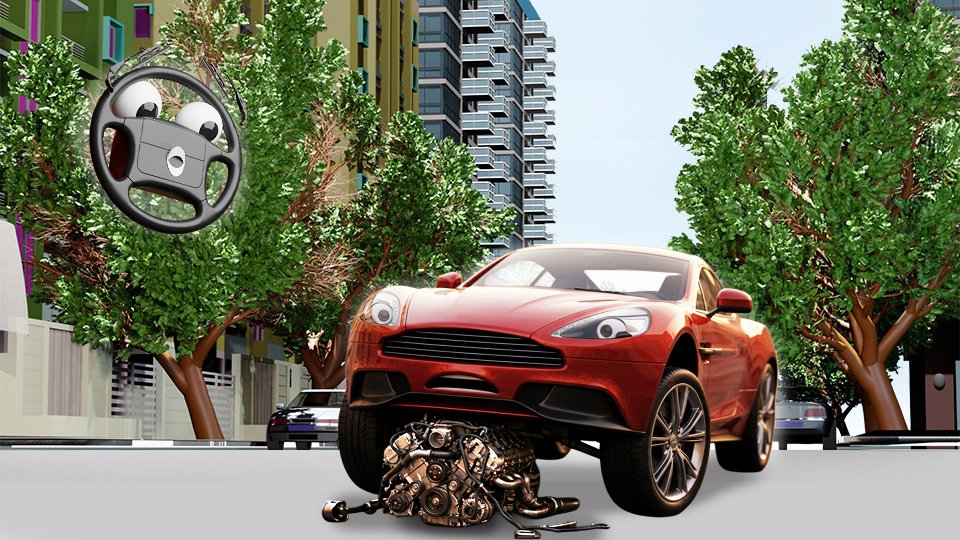
Amanda has always mentally filed everything car-related into one single, undifferentiated bucket labeled “car stuff that costs money” — an oil change, a brake job, the time her alternator died on a random Tuesday, all just interchangeable entries on the same long list of things her car occasionally demands from her wallet. It’s a completely understandable way to think about it. It’s also exactly the framing that makes it so easy to skip the cheap stuff — right up until the cheap stuff turns into the picture above.
🚗 What You’re Looking At
That’s not a repair. That’s what happens after a repair got ignored long enough to become a catastrophe — an engine that didn’t just break, it evacuated the premises.
Somewhere in that car’s history, there was a much smaller, much cheaper, much less dramatic moment where something could’ve been caught early.
This post is about that moment, and how to actually recognize it before it becomes a headline photo.
⚖️ Two Totally Different Categories, Wearing the Same Costume
Maintenance and repair both cost money, both happen to your car, and both involve a mechanic at some point — which is exactly why they get mentally lumped together. They’re actually opposites.
Maintenance is scheduled and preventive: something done on a known timeline, before anything’s actually gone wrong, specifically to keep it that way.
Repair is unscheduled and reactive: fixing something that’s already failed, usually at the worst possible moment, usually costing a lot more than the maintenance that would’ve prevented it.
🪢 How a Cheap Fix Turns Into an Expensive One
Here’s the pattern, and it repeats across nearly every system in a car:
Somewhere in your engine is a length of tough rubber called the serpentine belt. Shaped almost like a long, looping shoelace, it winds around several pulleys and quietly powers your AC, your power steering, and a few other things you’d genuinely miss if they quit working.
Replacing it on schedule is a cheap, routine service — done before anything’s wrong, over in an afternoon.
Ignore it long enough, though, and it eventually just snaps mid-drive, sometimes taking your engine’s cooling system down with it, and a cheap belt replacement quietly becomes an entire engine overheating on the side of the road.
Same story with something like your transmission’s fluid — the stuff that keeps its internal gears shifting smoothly. A fluid change is a modest, forgettable service. Ignoring it long enough can mean the transmission itself needs rebuilding — a repair that costs many times more than every fluid change that could’ve prevented it, combined.
💰 The Math That Makes This Worth Actually Caring About
As a rough rule of thumb, routine maintenance typically costs a fraction of what the equivalent neglected repair ends up costing — often several times less.
That’s not a scare tactic; it’s just what happens when a small, scheduled job gets replaced by an unscheduled, urgent one.
🕳️ Why Repairs Win the Attention War, Even Though They Shouldn’t
A repair demands your attention because the car is loudly, obviously broken right now — it won’t start, it’s making a terrible noise, there’s smoke.
Maintenance never announces itself like that. Nothing feels wrong yet, which is exactly why it’s so easy to put off — and exactly the window where fixing it is cheapest and easiest.
✅ The Mental Shift Worth Making
Every item on a maintenance schedule is really a small, cheap insurance policy against a much bigger bill later.
Taking an oil change or a belt inspection as seriously as an actual breakdown isn’t paranoid — it’s just the financially smarter way to think about it.
Stay ahead of the schedule, and you keep your car firmly in “boring, affordable, ask a shop to handle it” territory instead of “photographed on the side of the road” territory.
🛠️ Gear Worth Having
Vehicle Maintenance Log Book — the tool that keeps maintenance from quietly sliding into the repair category by making it easy to see what’s coming due.
Autel AL319 OBD2 Scanner — catch developing issues early, while they’re still a maintenance item and not yet a repair.
As an Amazon affiliate, I earn from qualifying purchases. Thank you for supporting GrumbleBump.
🔗 Related Reads
- How to Keep a Maintenance Log (and Why It’s Worth the Five Minutes)
- How to Actually Read Your Owner’s Manual Maintenance Schedule
- What Your Check Engine Light Codes Actually Mean (Before You Panic)
GrumblePark is part of the WhistleBump Group — find the rest of the family at WhistleBump.com.
42007
©2026 John D Reinhart/GrumblePark.com — All rights reserved