
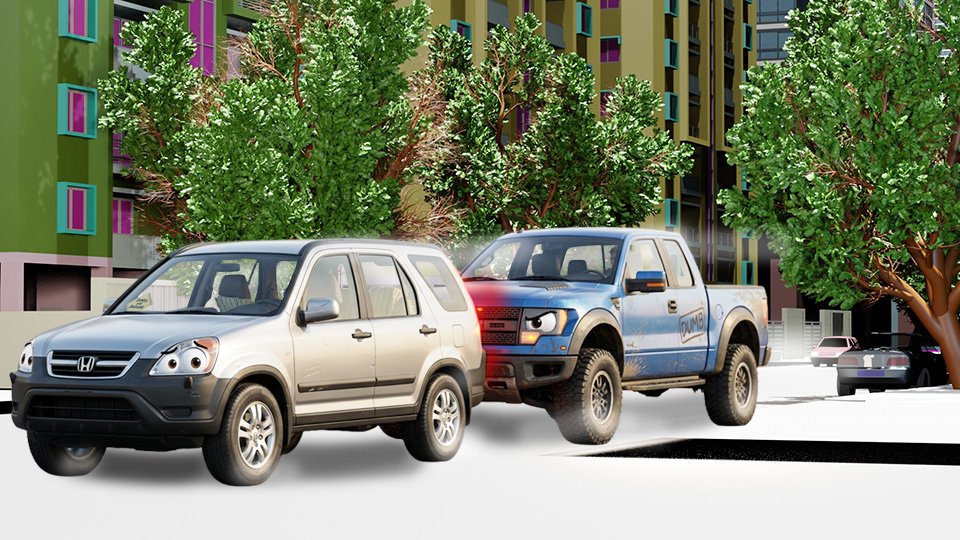
Every driver’s ed instructor in America seems to have learned the exact same eleven words: “count three seconds between you and the car ahead.” It’s tidy, it’s easy to remember, and it’s barely changed since long before anyone had a phone mounted on their dashboard. Chances are you learned it the same way — pick a fixed point, start counting, and if the car ahead beats you to it, back off.
It’s a good rule. It’s just not the whole rule — because “three seconds” at 25 mph in a school zone and “three seconds” at 75 mph on the interstate are not remotely the same amount of actual safety. Here’s what’s really going on, and what to do about it.
⏱️ How the Three-Second Rule Actually Works
Pick something fixed and easy to spot up ahead — a road sign, an overpass, even a particularly ugly pothole. The instant the car in front of you passes it, start counting: “one-Mississippi, two-Mississippi, three-Mississippi.” If you reach that same spot before you finish counting, you’re following too closely. Three full seconds is the traditional floor for a safe gap — not a target to aim for, a minimum not to dip below.
🧠 Why “Stopping” Takes Longer Than It Feels Like It Should
Here’s the part the three-second rule glosses over: “stopping distance” isn’t one thing, it’s two things stacked together.
First there’s reaction time — the gap between your eyes noticing brake lights ahead and your foot actually landing on the brake pedal. Even a fully alert, undistracted driver needs close to a full second for that. You’re not doing anything wrong in that second; that’s just how fast a human nervous system works.
Then there’s braking distance — the distance the car itself travels once the brakes are actually engaged, tires gripping, everything working the way it should. This is where speed stops playing fair.
Braking distance doesn’t grow at the same rate your speed does — it grows much faster, because the energy your brakes have to fight scales with the square of your speed, not with your speed itself. Practically, that means doubling your speed doesn’t just double how far it takes you to stop — it can roughly quadruple it.
Which is exactly why the flat three-second count starts working against you at higher speeds. Three seconds at 30 mph covers around 130 feet — comfortably more room than you actually need to stop.
Three seconds at 75 mph covers over 330 feet, but your real stopping distance at that speed has grown so much faster than your speed did that the same three-second gap now leaves you with a lot less breathing room than it felt like it should.
🌧️ Why Rain, Snow, and Fog Change the Number — Not Just the Speed
All of that math above assumes dry pavement and tires with good grip on the road. Take either of those away and the equation changes fast.
Wet roads mean less friction between your tires and the pavement, so braking distance stretches out — some safety organizations recommend doubling your following distance in rain.
Snow and ice go further still, with some recommending tripling it, because at that point your tires are fighting for grip on a surface that barely wants to give them any.
Fog is its own problem entirely: it doesn’t change your braking physics at all, it just shrinks how much warning you get before you need to react in the first place, so more distance buys you more time to notice trouble developing.
🚛 Why Big Vehicles Need Extra Room — Not Just Extra Respect
Riding close behind a truck, bus, or RV feels intimidating for good reason, but the real issue isn’t just nerves — it’s two genuine visibility problems happening at once.
First, you lose your own view of the road. A large vehicle blocks your sightline to whatever’s happening two or three cars ahead — brake lights, a sudden lane change, debris in the road — so you end up reacting to the truck’s brake lights instead of the actual situation, which costs you precious reaction time.
Second, if you’re riding in that stretch directly behind a truck’s rear bumper, there’s a real chance you’re sitting in the driver’s blind spot — close enough that their mirrors simply can’t see you’re there. A rough gut check: if you can’t see the truck driver’s side mirrors, assume they can’t see you either.
✅ A Better Mental Model Than One Fixed Number
Instead of treating “three seconds” as a rule you either follow or don’t, it’s more useful to treat it as a floor that moves depending on conditions.
Start at three seconds in good conditions on a dry road.
Add more as your speed climbs.
Add more again for rain, snow, fog, or anything else eating into your visibility or your tires’ grip.
And add more still behind anything bigger than your own car.
None of that requires new math while you’re driving — it just means treating “three seconds” as where the buffer starts, not where it ends.
🛠️ Gear Worth Having
REXING M2 Smart Mirror Dash Cam — documents your actual following distance and any incident objectively, which matters if a tailgating collision ever turns into a dispute.
ACCUTIRE Digital Tire Gauge — correct tire pressure is part of the real stopping-distance equation, not just a following-distance afterthought.
Rain-X Latitude Water Repellent Wiper Blades — better visibility in rain means more warning time, which is exactly what a longer following distance is trying to buy you — and it’s a simple, tool-free install.
As an Amazon affiliate, I earn from qualifying purchases. Thank you for supporting GrumblePark.
🔗 Related Reads
- Defensive Driving Fundamentals That Actually Matter
- Tire Pressure and Handling: Why It’s Not Just About the Tires
- How to Drive Safely in Fog, Heavy Rain, and Low Visibility
GrumblePark is part of the WhistleBump Group — find the rest of the family at WhistleBump.com.
44008
©2026 John D Reinhart/GrumblePark.com — All rights reserved