
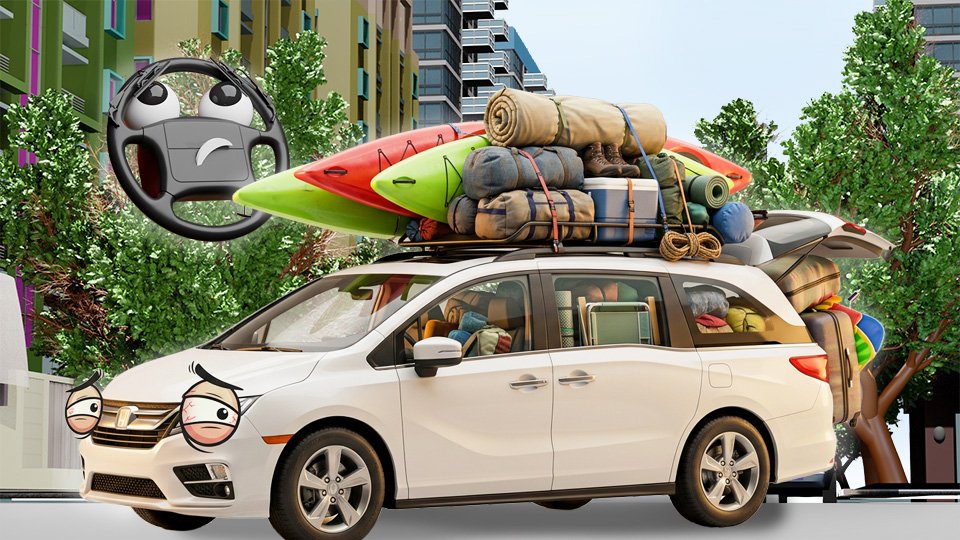
Armando has, on more than one occasion, packed the car, loaded the family, strapped questionable amounts of gear to the roof, and pulled out of the driveway for a genuinely long drive without so much as glancing under the hood on the reasonable-sounding theory that the car’s been running fine all month, so it’ll probably keep running fine for one more week.
Somewhere in Ohio, this theory tends to reveal its flaws.
🎒 Welcome to Auto Maint 101: The Pop Quiz Nobody Studied For
Here’s the good news up front: none of what’s below requires you to actually understand your engine, own a toolbox, or know the difference between anything and anything else under the hood.
This is a look-and-notice checklist, not a fix-it-yourself one.
Ten minutes of walking around your own car with fresh eyes before you ask it to do something much harder than the school run.
⏰ Do This a Day Early, Not the Morning Of
Here’s the trap almost everyone falls into, including people who know better: doing this checklist the morning of departure, car already packed, kayaks already strapped down, everyone already in the “let’s go” mindset.
At that point, a genuine inspection quietly turns into a glance — pop the hood, look for smoke or steam, see neither, close it, call it checked. That’s not actually catching anything; it’s just confirming the car isn’t currently on fire, which was never really in doubt.
The fix is almost embarrassingly simple: run this checklist the day before, or even two days before, while there’s still time to actually act on whatever you find.
A low tire becomes a five-minute stop at a gas station instead of a decision to just risk it. A cracked belt becomes a quick shop visit instead of a problem you now have to choose whether to ignore.
The entire value of a pre-trip check comes from having room to respond to it — do it with zero slack in the schedule, and you’ve built yourself an inspection that can only ever say yes.
🛞 Tires First, Because They’re the Only Part Actually Touching the Road
Every other system in your car is optional in an emergency. Tires are not — they’re the one part with zero backup plan.
Check the pressure while they’re “cold” (meaning the car’s been sitting for a few hours, not fresh off a drive) using a small gauge pressed onto the valve stem — that’s the little rubber nub sticking out of the wheel with a cap on it.
Compare the number against the sticker inside your driver’s door jamb, not the number printed on the tire itself (that’s a different, unrelated number — the tire’s maximum rating, not your car’s recommended pressure).
While you’re down there, run a hand across the tread and glance for anything embedded, or any cracking on the sidewall — the tall rubber wall between the tread and the wheel.
Don’t forget the spare. It’s easy to assume it’s fine because you’ve literally never looked at it.
🛢️ Fluids: The Under-the-Hood Circuit, Explained Like You’ve Never Opened It
Pop the hood (usually a small lever near the driver’s footwell, sometimes paired with a second release you pull right at the hood itself. Check your owner’s manual once and you’ll never forget it again.
Under the hood you’ll find a handful of translucent plastic containers with lines printed on the side marking “full” and “low.” That’s it. That’s the whole skill.
Oil, coolant, brake fluid, and washer fluid all get the same five-second glance: is the level between the lines?
If yes, move on. If it’s below the low line, that’s worth topping off before you go, not something to discover at mile 200.
🔋 Battery and Belt: The Thirty-Second “Nothing Weird, Right?” Check
Find the long rubber loop winding around several pulleys near the front of the engine — that’s the serpentine belt, and all you’re doing here is eyeballing it for cracks or fraying, the same way you’d glance at a shoelace to see if it’s about to give out. A belt that’s been fine for months of easy driving around town has a way of picking the middle of a six-hour highway stretch to reconsider its life choices.
Look at the two metal posts on top of your battery — if you see a crusty, blue-white buildup that looks vaguely like something growing in a fridge that’s been forgotten about, that’s corrosion. You should probably mention it to a mechanic before a long trip rather than after.
That corrosion is a completely typical thing to find — nearly every battery develops some over time. The challenge is that it acts like an insulator, getting in the way of the electrical connection, which can make it harder for the battery to deliver full power even if it’s otherwise perfectly healthy.
Cleaning it yourself is genuinely doable with the right tools, or an auto parts store can point you to what you need — some will even clean it for you on the spot if you’re already there buying a battery, though it’s worth asking rather than assuming.
💡 Lights and Wipers: The Stuff You Never Think About Until It’s Dark and Pouring
Have someone stand behind the car (or back up to a garage door, a window, anything reflective) while you cycle through headlights, brake lights, and turn signals — this takes about ninety seconds and catches a burnt-out bulb while you’re still safely in the driveway instead of getting pulled over three states from home.
And test your wipers on a dry windshield with the washer fluid running — streaky, dry-days-only wipers will fail you completely and immediately the moment real rain shows up, usually somewhere with zero cell signal and one van full of very disappointed kayakers.
📱 The One Gadget Move Worth Making
If you own a small code reader (a cheap little device that plugs into a port under your dash and tells you, in plain English, exactly what triggered any warning light — covered in its own post), a thirty-second scan before a trip can catch a developing problem while you’re still standing in your own driveway with time, tools, and a phone signal, instead of three states away with neither.
📋 The Whole Checklist, In the Order That Actually Makes Sense
- Tires (pressure, tread, spare)
- pop the hood, check the four fluid lines
- glance at the belt and battery terminals
- cycle the lights, test the wipers
- quick code scan if you’ve got the gadget for it.
Ten minutes, maybe fifteen if something needs topping off. Genuinely cheap insurance against becoming the road trip story everyone in the family retells for the wrong reasons, forever, at every future holiday.
🛠️ Gear Worth Having
ACCUTIRE Digital Tire Gauge — quick, accurate pressure checks on all four tires and the spare before you go.
DEWALT 20V MAX Tire Inflator — if a tire’s low, bring it up to spec in the driveway instead of hoping it holds.
Autel AL319 OBD2 Scanner — a quick pre-trip scan catches developing issues while you’re still parked at home.
As an Amazon affiliate, I earn from qualifying purchases. Thank you for supporting GrumblePark.
🔗 Related Reads
- How to Actually Read Your Owner’s Manual Maintenance Schedule
- The Serpentine Belt: What It Does and How to Spot Wear
- What Your Check Engine Light Codes Actually Mean (Before You Panic)
GrumblePark is part of the WhistleBump Group — find the rest of the family at WhistleBump.com.
42010
©2026 John D Reinhart/GrumblePark.com — All rights reserved