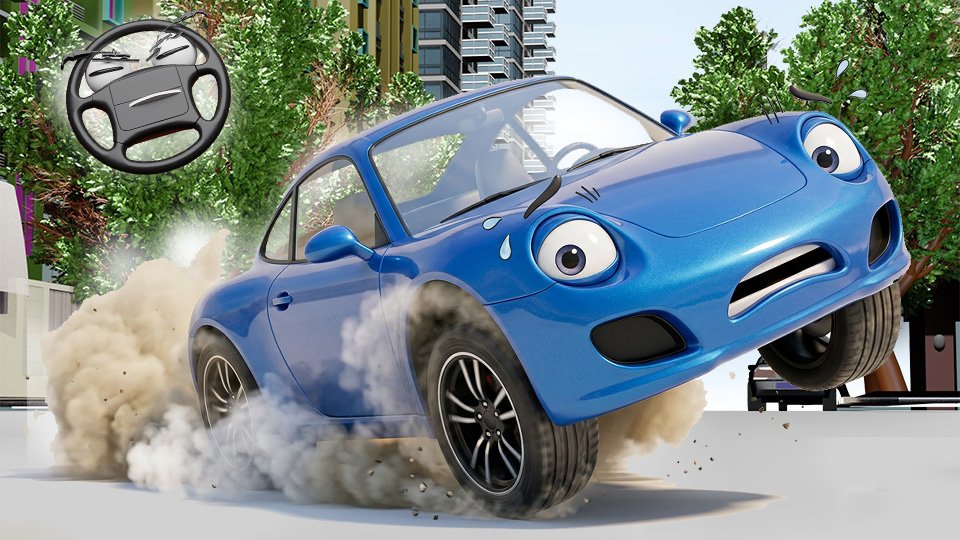
Armando has never actually experienced a real skid, has no idea what he’d do if he did, and has a vague, movie-informed instinct that involves turning the wheel dramatically in some direction — which is either exactly right or exactly wrong depending on a detail he’s never thought about: which wheels are actually driving his car.
↔️ The One Universal Rule First
In any skid, the first instinct you have to fight is braking hard — hard braking during a skid tends to lock wheels further and makes the loss of control worse, not better. Easing off the accelerator and avoiding sudden braking is the correct first move regardless of what kind of skid it is.
🌀 What Actually Is a Skid?
Here’s the plain version, no drama required: a skid is simply the moment your tires stop gripping the road the way they’re supposed to, and your car’s own momentum — the physics of a heavy object already moving in a direction — takes over instead. Normally, your steering wheel and pedals are in charge, because your tires are grabbing the pavement well enough to actually obey them. A skid is that relationship briefly breaking down. You turn the wheel, but the car keeps going roughly where it was already headed, because right now, physics is driving, not you.
That’s genuinely all a skid is — a temporary loss of grip, not some mysterious, car-possessed-by-a-poltergeist event. Which is good news, because it also means the fix is genuinely about getting that grip back, not fighting the car into submission.
🚨 How Do You Know You’re Actually Skidding?
This is the part movies never quite prepare you for, because on screen it’s all screeching tires and dramatic slow-motion. In real life, it’s quieter and stranger than that — and recognizing it fast is half the battle.
The clearest sign: you turn the steering wheel, and the car doesn’t respond the way it should. Not “responds a little slowly” — genuinely doesn’t turn as much as you’re asking it to, or the front of the car keeps sliding straight even with the wheel cranked over. The steering itself often feels oddly light or vague in your hands, almost disconnected, instead of the normal, solid resistance you’re used to feeling.
You might also feel the back of the car swinging out to one side, independent of what you’re doing with the wheel — a sideways sensation that’s genuinely different from the car simply turning. And yes, sometimes there’s a screech or a howl from the tires themselves, though plenty of real skids on wet or snowy roads happen almost silently, which is exactly why the steering-wheel feeling matters more than waiting to hear something dramatic.
One more modern tell, worth knowing: if your dashboard’s stability control light starts flashing, that’s your car’s own computer confirming what you’re feeling — it’s actively working behind the scenes to help regain grip. That flashing light isn’t a malfunction. It’s your car telling you it noticed the same thing you just did.
➡️ Understeer: The Front End Won’t Turn
Understeer is when the front tires lose grip first — you turn the wheel, but the car continues mostly straight.
The fix is counterintuitive: ease off the accelerator (which shifts weight forward onto the front tires, helping them regain grip) rather than turning the wheel harder.
⬅️ Oversteer: The Rear End Swings Out
Oversteer is the opposite — the rear tires lose grip first.
The correction is to steer gently into the direction the rear is sliding while easing off the accelerator, letting the rear tires regain grip before straightening back out.
🚗 Why FWD and RWD Cars Skid Differently
Front-wheel-drive cars, especially under acceleration, are somewhat more prone to understeer.
Rear-wheel-drive cars, especially under hard acceleration or on a slick surface, are more prone to oversteer.
🚙 Why Modern Cars Rarely Let You Feel This
Electronic stability control, standard on essentially every car built in the last couple of decades, actively brakes individual wheels to counteract both understeer and oversteer automatically, often correcting a developing skid before a driver would even consciously register it as one.
You may never notice the skidding sensation if the stability control kicks in soon enough. That means you may have already survived a skid a never known it!
🎯 One Phrase for When You Don’t Have Time for a Paragraph
Everything above is worth knowing ahead of time, but let’s be honest: nobody mid-skid is mentally reviewing the difference between oversteer and understeer. You’ve got about a second, maybe less, and your body needs something it can just do, not something it has to think through first.
So here’s the one line worth actually keeping in your head, the same wisdom driving instructors have leaned on for decades, boiled down small enough to survive the panic:
Ease Off, Eyes Ahead.
Ease off means your foot comes off the gas, smoothly, the one universal move that helps in every single kind of skid this post covers, no diagnosis required first.
Eyes ahead means look at where you actually want the car to go — not at the guardrail, not at whatever you’re afraid of hitting, but at the open road ahead of you.
Here’s the genuinely useful trick hiding inside that second half: your hands tend to steer wherever your eyes are pointed, almost automatically. Look at the danger, and you’ll often steer yourself right toward it. Look at the space you want to be in instead, and your hands quietly follow along — which happens to be exactly the correction both oversteer and understeer are asking for, without you needing to remember which one you’re in.
Four words. Ease off, eyes ahead. Worth saying it to yourself once right now, so it’s already sitting there the one time you’ll actually need it.
🛠️ Gear Worth Having
AutoSock Textile Snow Socks — genuinely reduces how often you encounter the low-traction conditions that cause skids in the first place.
REXING M2 Smart Mirror Dash Cam — documents exactly what happened if a skid does turn into an incident.
XOOL Emergency Warning Triangle Kit — worth having on hand for the aftermath of any roadside incident, skid-related or otherwise.
As an Amazon affiliate, I earn from qualifying purchases. Thank you for supporting GrumblePark.
🔗 Related Reads
- Winter Driving: Understanding Traction Before You Need It
- Tire Pressure and Handling: Why It’s Not Just About the Tires
- Defensive Driving Fundamentals That Actually Matter
GrumblePark is part of the WhistleBump Group — find the rest of the family at WhistleBump.com.
44007
©2026 John D Reinhart/GrumblePark.com — All rights reserved