
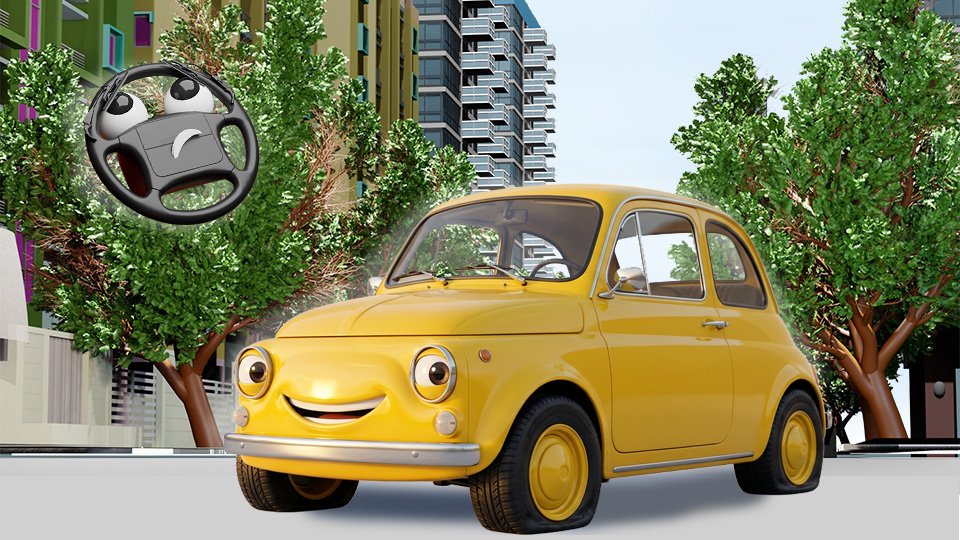
Amanda has always thought about tire pressure strictly as a wear-and-tear issue — just another number that she’s supposed to pay attention to. How much oil does it have? How much cooling stuff in the radiator? How much air in the tires? Just numbers.
The surprise is that those numbers all affect the operation of the car. In the tire’s case, it can seriously affect how well the car handles. And that, my friend, becomes a safety issue.
🏎️ The Contact Patch Is the Whole Story
Your car is not a light piece of machinery. It can weigh anywhere from three thousand pounds up to three tons, depending upon what it is.
That entire weight rests on the four rubber tires. They’re actually tubes that fit around your wheels, pumped up with air to absorb bumps in the road and give the wheels something with which to grip the road. The tires form the connection between your car above and the roadway below.
Every single thing a tire does — gripping in a straight line, braking, cornering — comes down to one small patch of rubber, roughly the size of your hand, actually touching the road at any given moment.
It’s a patch of rubber doing the same basic job everywhere on the tire, and that job is simply staying pressed flat and even against the road. When you turn a corner, the car’s weight shifts and leans onto the outer edge of the tire for that moment, so the edges do pick up more of the work then — but the second you straighten out, the load spreads back evenly across the whole tire again.
Stretch your hand as wide as you can. Now press it against a table. Which part touches first? That’s exactly like an overinflated tire: the center touches first.
Since the center of the tire is going the work of gripping the road, the edges barely get invited to the party.
Now cup your hand and put it on the table. That’s what underinflation looks like – it still holds the tire shape, but the center has no pressure on it.
🛑 Braking Distance Changes With Pressure
When you step on the brakes, the braking system hydraulically presses brake pads against the car’s wheel to slow it down. But the system relies on the tire’s connection to the road to actually stop the car.
A normally inflated tire is designed to handle the braking function with precision. The air cushion inside provides a rigid structure that helps the car stop correctly.
An underinflated, sagging tire allows a measurable degree of flex that counteracts the efficiency of the braking system. Although the car will stop, the flexing generates heat that reduces the life of the tire and can significantly increase the amount of distance the car needs to fully stop.
Conversely, an overinflated tire sitting high on the crown in the center doesn’t have much surface area to stop the car. That high center heats up, degrading the tire’s lifespan, and, because it doesn’t have as much tread as the whole tire, wants to skip and skid over the road until the car stops. Not safe.
↩️ Cornering Response Changes Too
Dashing around a corner with a set of properly inflated tires is a thing of joy. The car goes exactly where you point it, smoothly and speedily, no questions asked.
Tires that don’t have enough air? That’s another story. Because they sag, the tires allow the car to lean out beyond the contact patch just a little bit. The result is an unsatisfying, mushy control of the car. And that mushy control – you turn the wheel and the flexing tires put up a fight and a delay, could be a real safety issue in some circumstances.
Tires with too much air? Get ready for a harsh and bumpy ride, my friend. Now the tires are riding only on their centers – a contact patch that is smaller than what the car designer had in mind. Every bump comes through the steering wheel, and the car feels like it wants to skitter dart away on its own.
It’s all, and always, about safely controlling the car, isn’t it? You want the car to follow where you point it without question. A moment’s delay, a slight swerve, this way or that, could cause you a real problem in certain traffic situations.
🌡️ Why This Changes With the Seasons
In the hot summertime, your tires might show just a tick more pressure than what’s required. That small degree of overinflation is usually not enough to affect the car’s handling or braking.
But, sustained wintry conditions can cause the moisture in the air in the tires to condense. That condensation reduces the air’s pressure, dropping the the amount of inflation. The drop in inflation can actually affect the tire’s performance, and therefore the car’s handling.
It’s worth checking the pressure every now and then, regardless of the season. Just take a quick tire check every week or so. You’ll feel better knowing what’s going on down there.
⚖️ The Number That Actually Matters
But, how much is the right pressure? Excellent question!
You could just shoot air into it until it looks right. That’s not the wisest solution, as a few pounds above or below the correct inflation pressure could seriously affect the tire’s performance.
You could look on the side of the tire for something labeled PSI (per square inch). DON’T USE THAT NUMBER! That’s the maximum amount of air the tire will handle! Using that PSI will seriously OVERINFLATE the tire!
Believe it or not, the correct pressure printed on a placard inside the door jamb. Open the driver’s door and there it will be, along with some other vital information. That placard was put there before the car left the factory, so you know it’s right.
That, and only that, is the correct pressure for your tires.
🛠️ Gear Worth Having
ACCUTIRE Digital Tire Gauge — quick, accurate checks make it easy to stay at spec rather than guessing by eye.
JACO ElitePro Tire Pressure Gauge — a durable, precise second option for anyone who wants a gauge that lasts years.
DEWALT 20V MAX Tire Inflator — correcting a low reading immediately, in the driveway, rather than hoping it holds until the next gas station.
As an Amazon affiliate, I earn from qualifying purchases. Thank you for supporting GrumblePark.
🔗 Related Reads
- How to Handle a Skid (Front-Wheel vs. Rear-Wheel Drive)
- Following Distance: Why the Old Rules Don’t Account for Modern Speeds
- Winter Driving: Understanding Traction Before You Need It
GrumblePark is part of the WhistleBump Group — find the rest of the family at WhistleBump.com.
44006
©2026 John D Reinhart/GrumblePark.com — All rights reserved