
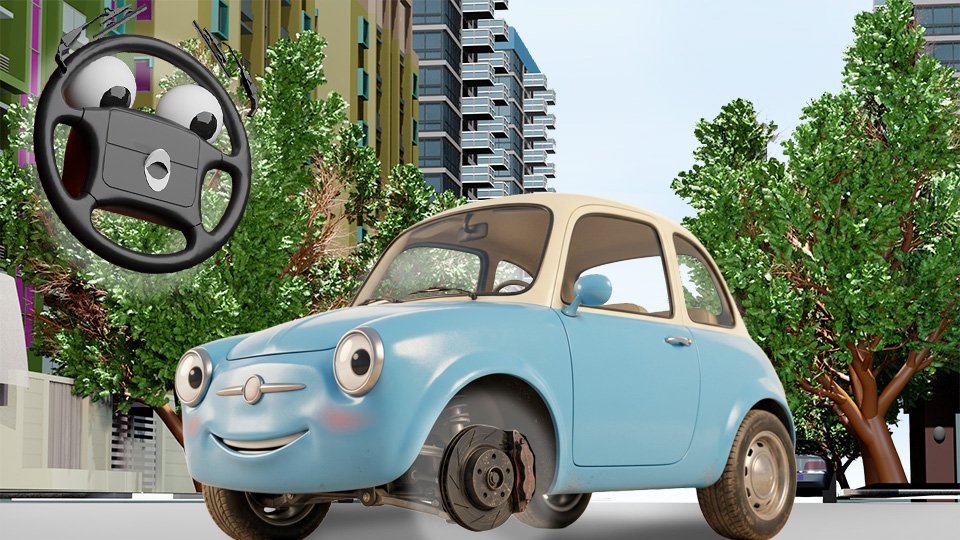
Amanda has pressed a brake pedal roughly a million times in her driving life and has never once had to think about what happens between her foot moving and the car actually slowing down — which is exactly how it should feel, right up until the moment you’re trying to figure out why it stopped feeling that simple.
🦾 Hydraulics: The Garden Hose Trick
Here’s the whole secret to how brakes work, and you already understand it: liquids don’t squish.
Cap one end of a garden hose, push water in the other end, and that pressure shows up everywhere in the hose at once, instantly, because the water has nowhere to compress into.
Your brake system uses that exact trick. Pressing the pedal pushes a piston into a sealed chamber called the master cylinder, which shoves brake fluid through sealed lines running out to all four wheels — and because that fluid can’t compress, your foot’s push arrives at every wheel at once, in an instant.
There’s also a helper in the mix called a brake booster, which just means something (engine vacuum, or an electric pump on some cars) is quietly making your foot’s push stronger than your leg alone could manage. You’re not muscling the car to a stop — the system is doing the heavy lifting, your foot is just giving it the signal.
🔵 The Caliper: Where a Push Becomes a Squeeze
At each wheel, that traveling pressure reaches a part called the caliper — think of it like a C-shaped clamp that straddles the spinning disc.
The pressure pushes a small piston inside the caliper, and that piston squeezes two brake pads against that disc from both sides, like pinching something between your thumb and finger.
That squeeze is the entire mechanical event. Everything upstream of it — the pedal, the fluid, the lines — exists purely to deliver force to this one pinching motion.
🔴 The Rotor: Where Squeezing Turns Into Heat
The disc being squeezed is called the rotor, and it spins along with the wheel.
Squeeze two rough surfaces against a spinning disc and you get friction, and friction turns motion into heat — that’s not a side effect, that’s literally the physics of how a car slows down.
All that speed you were carrying has to go somewhere, and it goes out as heat, right there at the rotor. That’s why rotors get genuinely hot after hard braking, and why they’re designed with heat in mind, not just strength.
🧱 Pads: Built to Wear Out on Purpose
Brake pads are made from a material that’s deliberately softer than the rotor — which sounds backwards until you realize why.
A pad is designed to be the part that wears down and gets replaced every so often, precisely so the rotor (a bigger, more expensive piece of metal) doesn’t have to.
It’s the same idea as a pencil eraser wearing down instead of the pencil — a sacrificial piece, on purpose, doing its job exactly as intended every time it gets a little thinner.
🧭 Why Knowing This Chain Actually Helps
Every brake symptom you’ll ever run into — a grinding sound, a shaky steering wheel, a pedal that feels soft — is just one specific link in this exact chain, misbehaving in one specific way.
Once you know the chain (pedal → fluid → caliper → pad → rotor), every future brake mystery stops being a brand-new puzzle and starts being “oh, that’s the pad part” or “oh, that’s the fluid part.”
You don’t need to fix any of it yourself for that to be useful — just knowing which link is talking to you is most of the battle.
🛠️ Gear Worth Having
Camrusic Brake Pad Thickness Gauge — now that you know what a pad actually is, this lets you check your own with a real number instead of a guess.
HeroBeam Car Emergency Flashlight (Twin Pack) — shine it through the wheel spokes and you can actually see the caliper, pad, and rotor you just read about.
ABN Mechanics Automotive Stethoscope Kit — listen to the system in action, useful groundwork for the noise-related posts still to come.
As an Amazon affiliate, I earn from qualifying purchases. Thank you for supporting GrumblePark.
🔗 Related Reads
- How to Tell If Your Brake Pads Need Replacing
- Ceramic vs. Semi-Metallic vs. Organic Brake Pads
- Warped Rotors: What Causes the Steering Wheel Shake
GrumblePark is part of the WhistleBump group – find the rest of the family at WhistleBump.com.
45001
©2026 John D Reinhart/GrumblePark.com — All rights reserved